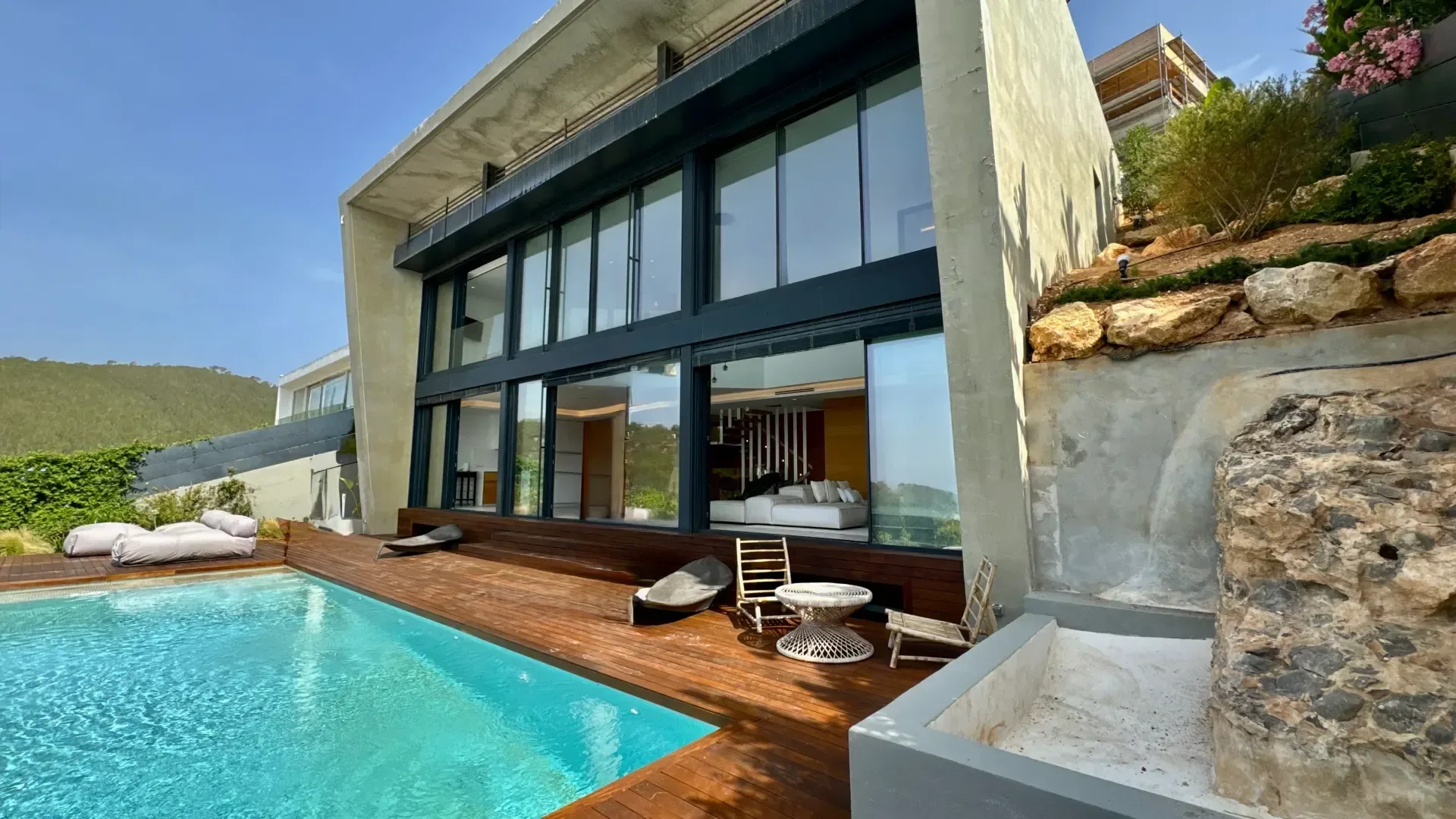
How much does it cost to build a house in Ibiza
What really drives the price of building on the island, why it costs more than on the mainland, and how to read a construction quote without nasty surprises.
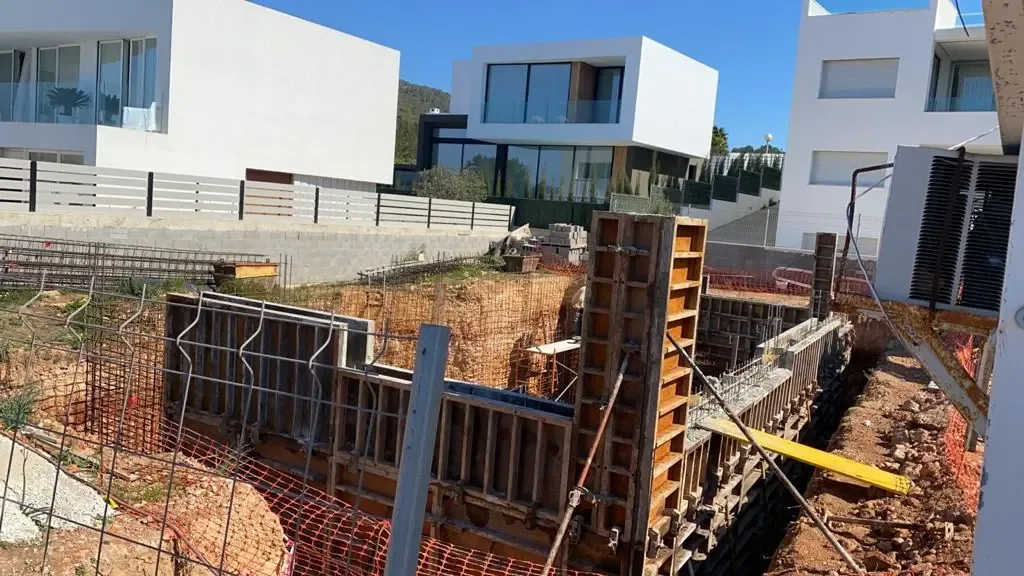
It is the first question in almost every conversation we have, and the hardest to answer over the phone. Not because there is anything to hide, but because the price of a house in Ibiza depends on decisions that, when someone calls us, have not been made yet.
Even so, a useful answer is possible. Here is what the cost depends on, what ranges we work with, and — above all — how to read a quote so you can tell whether it is realistic or whether it is hiding half the job.
The short answer
Our new-build projects with quality finishes start at around €3,000 per built m². A 300 m² house with a pool, home automation and high-end materials sits, indicatively, between €900,000 and €1,500,000 in construction cost.
That figure is the building work only. It does not include the plot, professional fees, municipal taxes and charges, or furniture. Confusing the construction budget with the total project cost is a very common — and very expensive — mistake. We break down everything that sits around it further down.
And an honest warning: any price per square metre is an average that hides enormous variation. A 200 m² house on a flat plot with vehicle access and services at the boundary has nothing in common with a 200 m² house on a slope with no track to it. They can be 40 % apart on cost with the same brief and the same finishes.
Why building in Ibiza costs more
Compared with inland mainland Spain, building on the island comes out between 20 % and 40 % more expensive. The reasons are structural, not opportunism:
Everything arrives by boat. Cement, steel, ceramics, joinery, sanitaryware. Every material carries a sea freight and an unloading logistic that simply does not exist on the mainland. For heavy, low-unit-value materials — aggregates, blockwork, mortar — the freight can be a noticeable share of the price.
Labour is scarce and seasonal. The island competes for the same trades with hospitality and with the maintenance of thousands of seasonal homes. In spring, when everyone wants their house ready for the summer, the good teams are already committed. Programming the work against the tourist calendar is one of the most effective ways of avoiding cost overruns.
The windows for work are narrower. In tourist areas there are noise and working-hour restrictions in high season, and certain operations — earthworks, pumped concrete pours — are best concentrated outside the busiest months.
The planning rules are demanding. Ibiza protects its territory very strictly, with conditions on coverage, height, volume, façade treatment, drainage and water management. Complying is mandatory, and doing it properly has a cost that does not appear in a cheap quote.
What actually moves the price
In order of real impact, not in order of what usually gets discussed:
1. The plot
This is the most underestimated factor. Before anything is drawn, it determines the cost:
- Slope. Sloping ground demands retaining walls, more excavation and sometimes structure to bridge the hillside. It is the overrun most people do not see coming.
- Access. If a concrete mixer cannot reach, it has to be pumped. If a lorry crane cannot get in, loads have to be split. Everything gets more expensive.
- Ground conditions. The island’s rock can appear very close to the surface. Excavating rock costs several times what excavating soil does.
- Services. Bringing water, power and drainage from a distance is paid by the metre. And if there is no mains drainage, treatment has to be resolved on the plot.
2. Geometric complexity
A house of straight volumes is not the same as one with curves, long cantilevers, double heights and many corners. Every structural singularity and every linear metre of junction between materials is hours of skilled labour. A simple plan, well resolved, is always cheaper than a complicated one — and almost always better.
3. The envelope and the joinery
Large glazed openings are the most characteristic device of contemporary architecture on the island, and also one of the heaviest cost items. High-performance joinery — thermally broken profiles, low-emissivity glass, hardware treated against salt air, large motorised leaves — can account for 10-15 % of the construction cost. Dropping quality here is the most common false economy: bad joinery can be seen, heard and felt in the energy bill for thirty years.
4. The finishes
Here the range is enormous, and it is where the client has most room to adjust. Between a decent porcelain tile and a large-format natural stone laid with minimal joints there is a difference of several times over — in material and, above all, in hours of laying.
5. Building services
Home automation, zoned climate control, underfloor heating and cooling, air-source heat pumps, solar panels, water treatment, lighting built into the fabric. Each layer adds material and coordination. Many pay for themselves; others are pure indulgence. It is worth deciding on them with judgement rather than from a catalogue.
6. The pool and the outdoor areas
A pool is not a small extra. Tank, structure, filtration, heating, lighting and the treatment of its immediate surroundings. And the landscaping, external paving, garden lighting and walls can add a very significant figure on a large plot.
What sits around the building work
These items are not invoiced by the builder, but they are part of the total cost. For planning purposes, they need counting:
| Item | Order of magnitude |
|---|---|
| Architectural design and site supervision | 6-12 % of the construction budget |
| Building permit and municipal charges | Varies by municipality, usually 3-5 % |
| Geotechnical and topographical surveys | A few thousand euros |
| Health and safety study and coordination | A minor percentage of construction |
| VAT on construction | 10 % on new-build housing |
| Furniture and equipment | Entirely dependent on scope |
The reduced 10 % VAT rate applies to residential construction under the terms set by Spanish law; it is worth confirming with your adviser for your specific case, because there are situations where it changes.
How to read a quote without nasty surprises
When you compare offers, look at this before you look at the final number:
Is it measured or estimated? A serious quote is broken down by items, with measured quantities and unit rates. A quote that is one sheet with six lines and a round total is not a quote: it is an intention.
What is excluded? The small print is where the overrun lives. Look explicitly for: earthworks and rock excavation, retaining walls, service connections, waste management, builder’s work in connection with services, and final cleaning.
How are the unknowns handled? No building job comes out exactly as drawn. What distinguishes an honest quote is that it sets aside an allowance for contingencies and explains how changes of scope are approved in writing.
Is there a certification schedule? There should be a payment plan tied to work executed and certified, not to calendar dates. Paying against real progress is your main protection.
Who manages the site day to day? Ask who will be on the plot, how often, and how many jobs they are running at once. It is the question that best predicts how the work will turn out, and almost nobody asks it.
Be wary of the cheapest. In construction, a price far below the rest almost never means greater efficiency. It means something has not been counted, that the finishes are different, or that the overrun will arrive later, when you can no longer change contractor.
How long it takes
As a reference, for a complete detached house:
- Design and permit: 6 to 12 months. This is the least predictable stage and the one most people underestimate.
- Construction: 12 to 18 months for a medium-sized house.
- Interiors and equipment: 2 to 4 months, overlapping with the end of construction.
Counting from the first idea to the keys, two years is a realistic timescale. If someone promises you far less, ask them about the permit.
How we give a price
We do not give figures over the phone, because a figure without a plot and without a brief helps nobody: it either frightens you or misleads you.
What we do, free of charge: see the plot, understand what you want to do, and tell you frankly what range it falls into and what constraints we can see. If the project is not a fit for what we do well, we say that too.
Then, with an architectural design on the table, we prepare a quote by measured items, with unit rates and the exclusions written legibly.
Frequently asked questions
Can I build on any plot in Ibiza? No. Island planning rules heavily restrict building on rural land, and there are conditions on minimum area, coverage, height and landscape protection that vary by municipality and by land category. Before buying land with the intention of building, its real development potential must be verified. It is the check that prevents the most grief.
Is renovating cheaper than building from scratch? Not necessarily. A full renovation involving structural work, services and roof can approach the cost of a new build, and with more uncertainty, because until it is opened up you do not know what is there. In exchange, an existing house may have volume or a location that could no longer be obtained today.
What if the budget drifts during construction? It should be anticipated in the contract. In our case, any change of scope is documented and approved in writing before it is carried out, with its effect on price and programme. Overruns discovered at the end are always a management problem, not bad luck.
Do you work with the architect I choose? Yes, and that is the norm. We work well with studios from outside the island who need a builder who knows the local planning rules, the trades and the lead times.
If you have a plot or a house in mind and want an honest estimate before committing to anything, tell us about your project. The first conversation costs nothing and usually saves a fair amount.
budgetnew buildpermitscosts
Keep reading
Building a villa in Ibiza: from the first idea to the keys
The six stages of a build told without decoration: what is decided in each one, how long they last, and when to involve whom.
Read
What to check before building a house in Ibiza
The seven checks worth making before buying a plot or commissioning a design on the island. Written from the site, not from an office.
Read
Buying a house to renovate in Ibiza: what you should know
How to tell whether an old house is worth it before you buy, which overruns always appear once it is opened up, and when renovating beats building new.
Read