Stone, lime and timber: the materials that define Ibiza
Why the traditional Ibizan house was built with sandstone, lime and sabina wood, how those materials behave in sun and salt air, and what still makes sense today.
The traditional architecture of Ibiza did not choose its materials for taste. It chose them because they were to hand and because they worked. That the result also happens to have a beauty which has been drawing architects from all over the world for a century is, in a sense, a side effect.
The logic is worth understanding, because it still holds.
Stone: what the ground gave
The traditional Ibizan house was built with the stone that came out when clearing and excavating. Marés where it appeared — a soft sandstone, easy to cut by hand and to dress — and limestone rubble elsewhere, bedded in lime mortar or laid dry.
The walls were thick, half a metre or more. Not for show: for thermal inertia. A solid wall takes many hours to heat up, so the midday heat does not reach the interior until nightfall, when it can be ventilated. It is air conditioning by mass, with no plug.
That same stone built the márgenes: the dry-stone walls that hold the terraces on the hillsides. They are assembled without mortar, by fitting pieces together, which allows them to drain rainwater and to move slightly without cracking. It is a technique of enormous intelligence, and it remains the best way of resolving a level difference without it looking like a civil engineering job.
Today: natural stone is still unbeatable as a finish, and a dry-stone wall is still the right solution for a slope. What has changed is the cost of labour: a well-built terrace wall is skilled work and it shows in the budget. We no longer build half-metre load-bearing walls, though, because thermal inertia is now better achieved by combining mass with continuous insulation.
Lime: the cleverest material of all
The walls were lime-washed every year, before the village fiesta. That gesture, which today reads as an aesthetic tradition, did four things at once:
- It reflected the light. White returns most of the solar radiation. A lime-washed façade is appreciably cooler than a dark one.
- It disinfected. Lime is strongly alkaline and prevents fungi and mould.
- It let the wall breathe. Lime is permeable to water vapour. A lime-washed stone wall releases the moisture it absorbs, which is why it does not degrade.
- It repaired itself. Each new coat sealed the micro-cracks of the previous year.
Here lies the most frequent error in badly executed renovations of old houses: painting a historic wall with plastic paint. Plastic paint is an impermeable film. It traps moisture inside the wall, and that moisture eventually comes out wherever it can, blowing the finish and rotting the substrate. A traditional Ibizan house painted with plastic starts deteriorating the following day.
Today: in new build we use technical mortars and finishes, but in the rehabilitation of old masonry we still work with lime — and not out of romanticism: it is the only material compatible with what lies beneath.
Sabina wood
The sabina is the island’s emblematic tree, twisted by the wind and extremely slow-growing. Its timber is dense, highly resistant to moisture and insects, and practically impossible to find straight.
Traditional roofs were resolved with sabina or pine beams set at close centres, and over them a lattice of cane, a layer of dried seagrass — posidonia — as insulation and waterproofing, and compacted earth. That roof is a lesson in construction: each layer does one job, every material comes from less than a kilometre away, and the assembly insulates, waterproofs and provides inertia.
Today: sabina is protected and is not felled, so what is used is reclaimed. What we do keep is the principle: timber indoors, always; outdoors, only with species and treatments prepared for sun and salt, and accepting that it will weather and needs maintenance. Teak and ipé cope; almost everything else does not.
Concrete, the new material that fitted
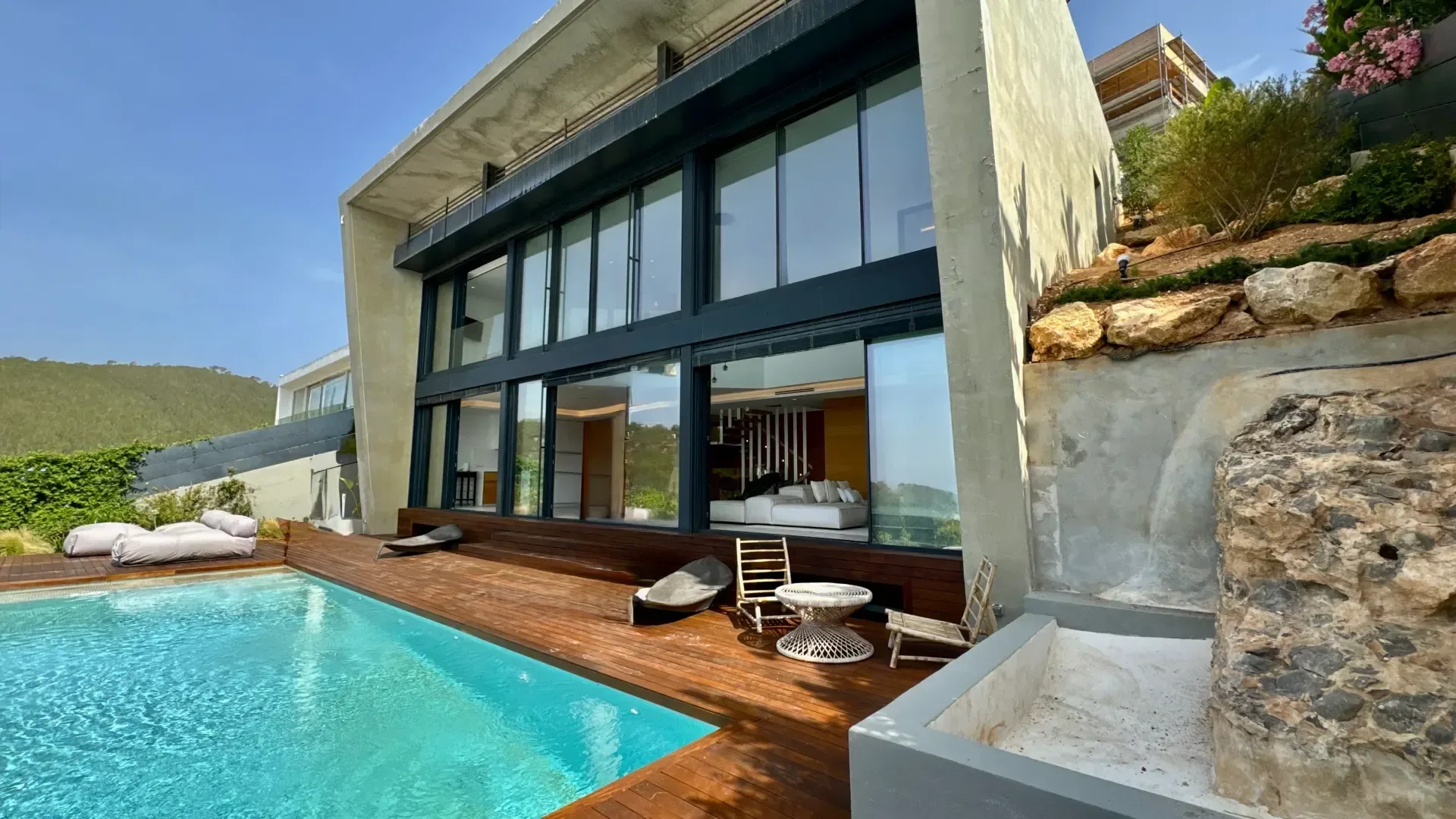
It may sound contradictory, but exposed concrete coexists extraordinarily well with the island’s architecture, and that is no accident.
It is mass, like stone: it provides thermal inertia. It has a mineral texture that weathers as limestone does, taking on tone rather than staining. And it allows long spans and cantilevers, which is how shade is built today — the cantilever is the contemporary equivalent of the traditional Ibizan porch.
The condition is that it be executed properly. Exposed concrete is a finish, not a structure to be painted afterwards: it demands careful formwork, controlled vibration, a consistent mix, and a joint layout drawn before the pour, because those joints will be visible forever. And in a marine environment it needs greater cover to the reinforcement, because the chloride in the air is what corrodes steel.
What salt air takes away
Any material within a few hundred metres of the sea lives in an aggressive environment. What we have seen fail, again and again:
- Cheap hardware and fixings. They rust within a season. On the coast, AISI 316 stainless steel, not 304.
- Aluminium with insufficient coating. It loses colour and pits. Marine-quality powder coating has to be specified.
- Economy joinery profiles. They seize up with salt in the tracks. A large sliding leaf that does not glide properly is a daily problem.
- External light fittings. High ingress protection rating and non-ferrous or stainless bodies.
- Gloss paint. Gloss shows up salt and dust. Matt holds up far better to the eye.
These are small items in a budget and large ones in the experience of living in the house. It is where we most strongly recommend not economising.
In summary
The traditional house of Ibiza is white because white reflects, thick because mass delays heat, with small openings towards the sun and large ones towards shade, and it is made from whatever lay within a kilometre. All of it has a climatic reason.
When we build today with concrete, large expanses of glass and large-format stone, we are not breaking with that. We are using new materials to answer the same questions: how to protect yourself from the sun, how to ventilate at night, and how to make a house weather well somewhere with salt in the air.
If you are thinking of building or restoring on the island and want to talk about materials before talking about prices, get in touch. It is our favourite conversation.
stonelimesabinaconcretevernacular architecture
Keep reading
Building a villa in Ibiza: from the first idea to the keys
The six stages of a build told without decoration: what is decided in each one, how long they last, and when to involve whom.
Read
Buying a house to renovate in Ibiza: what you should know
How to tell whether an old house is worth it before you buy, which overruns always appear once it is opened up, and when renovating beats building new.
Read
How much does it cost to build a house in Ibiza
What really drives the price of building on the island, why it costs more than on the mainland, and how to read a construction quote without nasty surprises.
Read